
Description
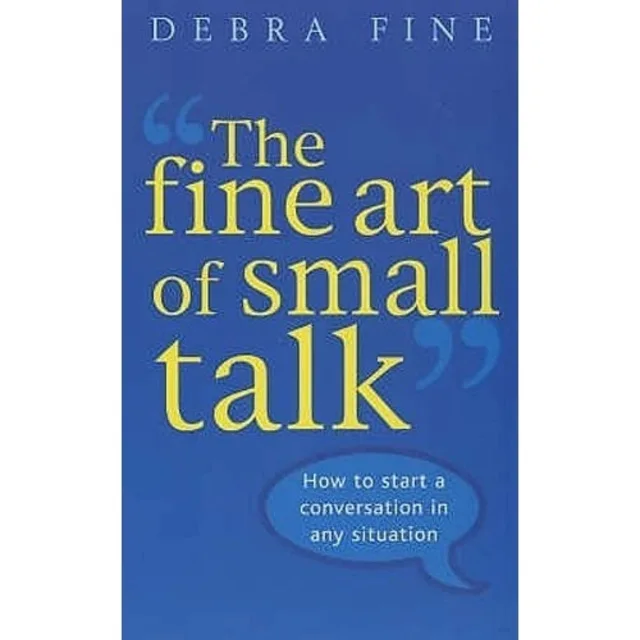
The Fine Art Of Small Talk: How To Start A Conversation – Debra Fine
The Fine Art of Small Talk by Debra Fine presents readers with practical advice on how to start, hold, and end conversations in both personal and business settings.
If you are looking to improve your conversation skills, the biggest reason to get the book is the number of conversation cheat sheets offered by the author.
The Fine Art of Small Talk Summary
Even though the book is a quick read, it is packed with a ton of useful tips, especially if you are not a good conversationalist.
It starts with Fine explaining why small talks are gateways to deep conversations and insights about a person.
She then presents actionable advice addressing common problems we face in a conversation or at a social event. The questions she answered in the book include:
How to break the ice?
What to say to revive a conversation from pregnant pauses?
How to join a group conversation?
Where to get conversation ideas?
How to exit a conversation?
For singles, there is also a chapter on how you can up your dating game.
Lesson 1: The Importance of Small Talk
People who are good at small talks make others feel included, valued, and comfortable.
There is a misconception that small talk is nothing but fillers to a conversation. Some even think it’s not necessary at all. But its absence prevents a conversation from going deeper and relationships from growing stronger.
Lesson 2: Prepare a List of Icebreakers
Keep a list of conversation starters, and go through them before joining any social event.
Here are some examples to help you get started:
Business
Describe the challenges of your profession.
What do you see as upcoming trends in your business?
Do you know someone who can help me?
Social/General
If you could replay any moment in your life, what would it be?
What one thing would you like to own? Why?
Tell me about your favorite travel destination.
What is a typical day like for you?
What’s the most memorable meal you’ve ever eaten?
You can also save the above to your phone. Step aside to take a peek at it when you run out of what to say.
Lesson 3: The Importance of Names
When you refer to people by their name in a conversation, it makes them feel special and shows that you’ve been paying attention.
Figure out a person’s name early on in a conversation. Ask for it. Once you have it, repeat it or start using it in the conversation. Doing so registers the name in your memory.
Calling people by a nickname or a shortened version of their name can be tempting, but they may not like it. Unless you have permission, always call people by the name they used in their introduction.
Lesson 4: Identifying a Target to Start a Conversation
In a social setting, the best person to approach for a conversation is one who makes eye contact with you.
You can also look for people who are not involved in a conversation. They are usually looking down at their phone or typing away on their computer.
Lesson 5: How to Join an Existing Conversation
Sometimes, you want to speak to someone who keeps getting pulled into different conversations. You can wait for your turn, but you might not stand a chance if the person is a popular figure.
In the book, Fine offers two ways to tackle this.
The first is to wait for a pause in the existing conversation. When that happens, interrupt the person you’re not interested in speaking to, and ask if you can talk to his/her conversation partner. Most of the time, you’ll get a yes out of courtesy.
The second option is to excuse yourself into the conversation and tell the person you want to speak to about your intention to catch up. You might get pulled into the conversation right away, or the person might search for you later at the event.
If neither of these happens, at least the person knows you made an effort to reach out.
Lesson 6: Ask Open-Ended Questions
Never ask questions warranting just a yes or no answer. Use the following phrases or questions instead:
“Describe for me…”
“Tell me about…”
“How did you…”
“What was that like for you?”
“Why?”
In a conversation, always try to dig deeper. Ask the person to tell you more. It indicates your interest in the topic.
There are also many cues for open-ended questions around you in any setting. Watch out for them and use them to fuel your conversations.
Appearances: Clothing, hairdo, a badge, or any other accessories.
Team apparel and items with a logo: These show a person’s affiliation with or affinity towards an organization or sports team.
Office and home decorations: Art pieces, sports equipment, or a photo.
Location and occasion: The motivation to be at an event, the host, where a person is from, or an agenda item.
Behavior: An action the person did, a facial expression, or how one speaks or writes.
Lesson 7: Be Attentive in a Conversation
The biggest block between two people is their inability to listen to each other intelligently, understandingly, and skillfully. – Carl Rogers
Maintain eye contact when you are having a conversation. Don’t look around. Nod occasionally to show the speaker you’re following along.
Avoid making small gestures such as tapping a pencil or pen, scratching another part of your body, or crossing your arms. They make you seem uninterested in the conversation.
Here are a few lines from the book that you can use to acknowledge what the speaker is talking about and to show your interest:
To show interest in hearing more:
Tell me more.
What was that like for you?
To seek specifics:
Can you give me an example?
To review the past:
What happened first?
To probe:
What do you mean by that?
How were you able to manage?
To empathize:
That must be tough.
Lesson 8: Prepare for Pregnant Pauses with Jumpstarters
Have you been in a situation like this?
You are in a conversation. Out of nowhere, it grinds to a halt. It is as though someone casts a spell, and both of you become quiet. You start checking your phone, and neither of you has a clue to get the conversation going again.
Fine’s advice is to prepare for situations like this in advance. Keep a list of jumpstarters to bring a conversation back to life.
To help you to come up with the list, Fine offers four categories of questions for any social situation. FORM is the acronym you can use to remember these categories.
Family: Tell me about your family. What do you like best about being a father/mother/aunt, etc.?
Occupation: What got you into your current job? If you could change one thing about your job, what would it be?
Recreation: How do you exercise? How do you spend your free time?
Miscellaneous: Have you seen any good movies lately? Are you reading anything you enjoy?
Before you go all out brainstorming for ideas to restart a conversation, keep in mind that there are topics you shouldn’t bring up. The person you’re talking to may feel awkward or unpleasant if one of these topics come up:
Stories of questionable taste
Gossips
Personal misfortunes
Controversial subjects where you don’t know where people stand
Health issues
Lesson 9: Avoid Committing Conversation Crimes
Fine dedicates an entire chapter in the book to eight conversation crimes. Each of them has unique characteristics and a fun name.
If you are unlucky enough to encounter one of them in your conversations, she has tips on how to take them on too.
Out of the eight “criminals,” these are the five that you can probably relate to:
The FBI Agents
They use interrogation-style questions and one- or two-word answers in conversations.
Solution: Ask open-ended questions and help them expand on the answers given by probing them for more.
The Braggarts
They brag about their accomplishments regardless of how big or small they are. You might sense a little arrogance when talking to them.
Solution: Bring the conversation back to more general topics such as current events.
The One-Uppers
As the name goes, one-uppers try to one-up everybody in a conversation. They seek to either match or trump another person’s story to get all the attention. “Been there, done that.” is their favorite statement.
Solution: Redirect the conversation back to the person who was speaking before the one-upper.
The Monopolizer
They dominate conversations by going on-and-on without passing the ball to someone else.
Solution: Try to end the conversation. If you are in a group conversation, try to bring others into the dialogue. You can do that by asking anybody other than the monopolizer a question.
The Adviser