
Description
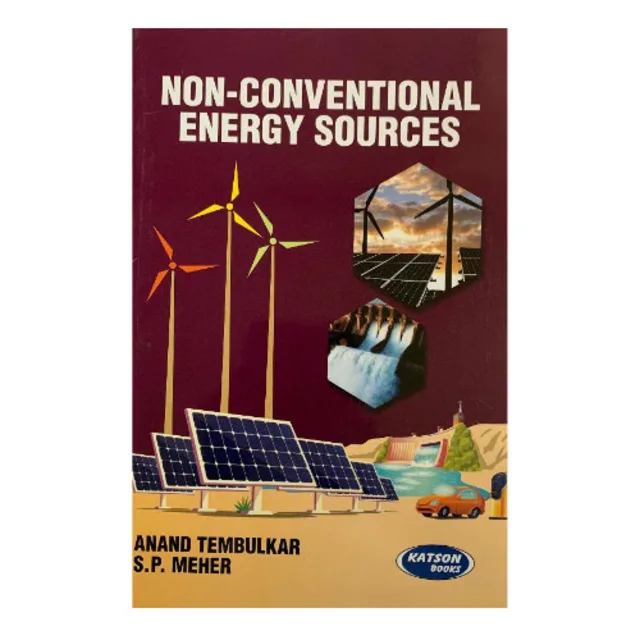
Non- Conventional Energy Sources By Anand Tembulkar. 3rd Edition 2021 – Paperback
Non- Conventional Energy Sources
The present book is among the many books available in the market on the subject of Non-conventional Energy Sources by various titles. This bookie written by keeping in mind the latest syllabus of Board of Technical Education ITE), Delhi which is made effective from the academic year 2012-13. it won he useful to both diploma and degree students of Electrical Engineering and other disciplines. The book deals with various aspects of Non-conventiand Energy and covers all the topics of the syllabus. Each topic namely, Enersy Resources; Solar Energy; Wind Energy; Wave Energy; Tidal Energy; Geothermal Energy; Biomass Energy; Small Hydro Power Plants; Fuel Cells; Ocean Thermal Energy Conversion (OTEC) is given a full chapter. Relevant terms and definitions are given in every chapter so that the fundamental concepts could be easily understood and grasped.
The fundamental concepts and descriptions are followed by the analvsis in the form of comparisons; advantages and disadvantages; limitations and challenges; environmental impacts. Various energy sources have been dealt with giving their future potential along with the present status of utilisation. Particular emphasis is laid on the current energy situation in India. The authors tried their level best to provide new and updated information. Now-a-days there is an increasing trend of very short answer type, short answer type questions in various board exams, University and competitive exams. The book, we hope, will be helpful in this regard also. To give more objectivity to the questions, following pattern of questioning is given. Define, List, Enumerate, Classify, Write full form of, State true/false giving reasons, Fill in the blanks, Choose the correct option (MCQ) and so on.
The book deals with various energy sources in such a way that the teacher/ student has the liberty to take any chapter out of the ten chapters without following a fixed order or sequence. We thank Sh. Sanjeev Kataria for S. K. Kataria and Sons who took keen interest in publishing the book. He accomplished the work in a very short span of time. We are thankful to Mr. Manoj Tyagi, Mr. Sanjay Kumar of Plus Computers and Mr. Sharda Singh and other staff members of S.K. Kataria & Sons and Sh. Azad Ahmed for their sincere efforts towards bringing out the book. Suggestions for improvements and corrections in the book are welcome and will be highly appreciated.