
Description
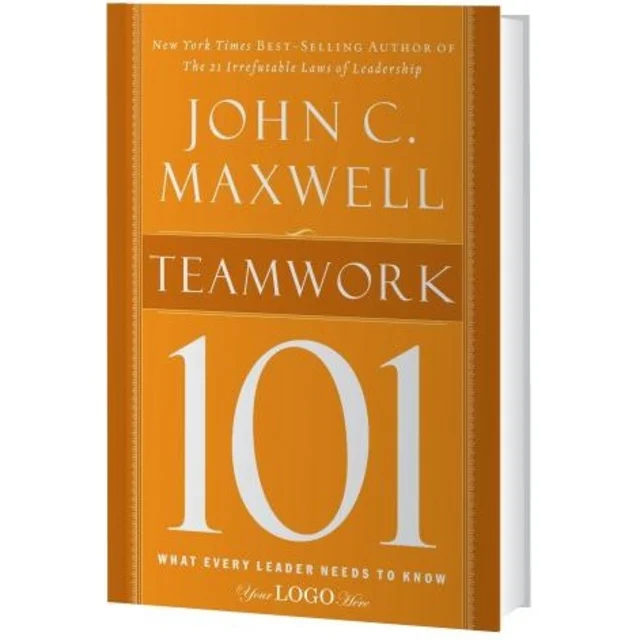
Teamwork 101 By John Maxwell
You and your team will love our Teamwork 101 by John Maxwell. For every leader who has ever wondered what level of excellence their team could achieve, Teamwork 101 lays out a plan packed with insight to get them there. John C. Maxwell believes that “teamwork is at the heart of great achievement. The question isn’t whether teams have value. The question is whether we acknowledge that fact and become better team players.” In Teamwork 101, Maxwell draws on leadership wisdom from his various books on teamwork and leadership. This concise, power-packed game plan can help leaders create an environment that brings about victory and fulfillment to the whole team. Hardcover, 122 pp.
Create the Perfect Gift!
Add your company logo to the cover!
Add a custom page inside the book!
Create a completely custom book jacket using your own artwork.
Talent wins games, but teamwork wins championships.
“Teamwork is always at the heart of great achievement,” says New York Times best-selling author John C. Maxwell. “The question isn’t whether teams add value. The question is whether we will acknowledge that fact and work to become better team players.” This concise, power-packed game plan can help you create an environment that results in victory and fulfillment for the whole team. Learn to:
Build a team that lasts
Create positive energy on the team
Harness a team’s creativity
Identify weak players who negatively impact a team
Judge if the team can accomplish the dream
…
I believe that insecurity, rather than poor judgment or lack of intelligence, most often causes leaders to surround themselves with weak people.”
“On good teams, trust is a nonnegotiable. On winning teams, players extend trust to one another. Initially that is a risk because their trust can be violated and they can be hurt. At the same time that they are giving trust freely, they conduct themselves in such a way to earn trust from others. They hold themselves to a high standard. When everyone gives freely and bonds of trust are developed and are tested over time, players began to have faith in one another. They believe that the person next to them will act with consistency, keep commitments, maintain confidences, and support others. The stronger the sense of community becomes, the greater their potential to work together. Developing a sense of community in a team does not mean there is never conflict. All teams experienced disagreements. All relationships have tension. But you can work them out.”
“Create an environment that unleashes new leaders.”
“Teams that don’t bond can’t build.”
“For a team to be successful, the teammates have to know they will look out for one another.”
“In a sport such as basketball, the players on the team recognize that scoring is what is important. When a team is more effective at scoring than the opponent, it wins. Because the team members know that, they spend their time in improving and perfecting their ability to score. That is their focus. In contrast, in many organizational settings, the team members don’t know what it means to ‘score.’ They may have a list of duties, but they don’t know how those duties go together to make a score. It would be the equivalent of a basketball player who knew how to set a pick, dribble, and pass, but who never knew all the skills were used together to score baskets. If just one player on a basketball team doesn’t know what is important to the team, it makes him ineffective. And when he is in the game, it is impossible for the team to succeed. The same is true in any organization. Anyone who doesn’t know what’s important to the team not only fails to contribute to the team, but actually prevents the team from achieving success. That is why it is so important for leaders of the team to identify what is important to the team and to communicate that information to her team members.”